Why the score varies
This ingredient is made commercially by more than one route, and ISO 16128 scores the feedstock actually used. Without a supplier certificate of origin the value cannot be claimed.
| Route | Feedstock | NOI | Share | Notes |
|---|---|---|---|---|
| Natural-source acetylation | Soy or sunflower oil distillate + acetic anhydride | 0.91 | About half of cosmetic supply | Acetyl cap petrochemical |
| Total synthesis (dl-alpha) | Trimethylhydroquinone + isophytol (petrochemical) | 0.00 | About half | Fully synthetic |
How we scored it
How it’s made
Where it comes from
Two commercial grades: natural-source (soy or sunflower deodoriser distillate, acetylated) and fully synthetic dl-alpha. Cosmetic use is split; confirm the grade with the supplier.
The industrial synthesis of Tocopheryl Acetate involves the esterification of tocopherol (Vitamin E) with acetic anhydride. Tocopherol itself is commonly synthesized industrially starting from trimethylhydroquinone (TMHQ) and isophytol. TMHQ is typically produced from petrochemical precursors like pseudocumene or mesitylene through a series of reactions including alkylation, oxidation, and reduction.
Isophytol, the other key precursor, is also synthesized from petrochemical feedstocks, often involving acetone and acetylene. The synthesis of isophytol is a multi-step process that requires careful control of reaction conditions and catalysts. The combination of these two synthetic precursors yields alpha-tocopherol, the most biologically active form of Vitamin E.
The final step is the acetylation of alpha-tocopherol. This reaction is typically carried out by reacting tocopherol with acetic anhydride, often in the presence of a catalyst such as pyridine or a Lewis acid. The reaction is usually performed at moderate temperatures, typically between 50-100°C, to ensure efficient esterification while minimizing degradation of the sensitive tocopherol molecule. The reaction mixture is then quenched, and the product is purified through methods like distillation or chromatography to remove unreacted starting materials, byproducts, and catalysts, yielding high-purity Tocopheryl Acetate.
In plain English
Tocopheryl Acetate is a synthetic form of Vitamin E, a well-known antioxidant that helps protect the skin from damage caused by environmental factors like pollution and UV radiation. It's often added to skincare products to help preserve the product itself and to provide skin benefits.
This ingredient is made by chemically combining a synthetic version of Vitamin E with acetic acid. While Vitamin E naturally occurs in plant oils, the form used in most cosmetic products is manufactured in a lab using petrochemicals as the starting materials. This process ensures a stable and consistent ingredient that can effectively deliver its antioxidant properties to the skin.
Natural alternatives with the same function
A stabilised, water-soluble form of vitamin C used as an antioxidant and humectant in skincare. It is made…
Acacia Catechu Wood Extract 100% natural originAn extract of the heartwood of the black catechu tree, rich in plant polyphenols such as catechin. It…
Acer Palmatum Leaf Extract 100% natural originA plant extract from Japanese maple leaves, valued as an antioxidant. It's produced by simple extraction from the…
Achillea Millefolium Flower Extract 100% natural originAn extract made from yarrow flowers, a plant long used in traditional herbal preparations. Used to help condition…
Adenosine 100% natural originAdenosine is a naturally occurring compound found in all living cells, playing a vital role in energy transfer…
Aesculus Hippocastanum Extract 100% natural originAn extract from the horse chestnut tree, used to soothe and protect skin and tighten its surface feel.…
Structure
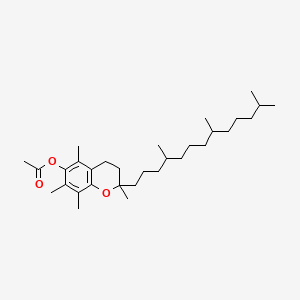
[2,5,7,8-tetramethyl-2-(4,8,12-trimethyltridecyl)-3,4-dihydrochromen-6-yl] acetate
References
- 1ISO 16128-1:2016 and ISO 16128-2:2017 — Guidelines on technical definitions and criteria for natural and organic cosmetic ingredients and products. ISO, Geneva.
- 2Tocopheryl Acetate. PubChem CID 2117. National Center for Biotechnology Information. pubchem.ncbi.nlm.nih.gov ↗
- 3TOCOPHERYL ACETATE. CosIng — European Commission cosmetic ingredient database. ec.europa.eu/cosing ↗
- 4TOCOPHERYL ACETATE. CosIng u2014 European Commission database for information on cosmetic substances and ingredients. https://ec.europa.eu/growth/tools-databases/cosing/search?search=TOCOPHERYL%20ACETATE