Why the score varies
This ingredient is made commercially by more than one route, and ISO 16128 scores the feedstock actually used. Without a supplier certificate of origin the value cannot be claimed.
| Route | Feedstock | NOI | Share | Notes |
|---|---|---|---|---|
| Rice-bran oryzanol hydrolysis / biomass extraction | Rice bran, corn fibre | 1.00 | Majority for cosmetics | Natural origin |
| Knoevenagel synthesis from lignin vanillin | vanillin from wood lignin + malonic acid (petrochemical) | 0.70 | Minority | vanillin part C8H8O2 136.15 Da natural of 194.18 Da |
| Knoevenagel synthesis from guaiacol vanillin | vanillin from petrochemical guaiacol + malonic acid | 0.00 | Minority | Fully synthetic |
How we scored it
Where it comes from
Dominant route: alkaline hydrolysis of rice-bran gamma-oryzanol, or bioconversion of agricultural biomass. Alternative: Knoevenagel synthesis from vanillin and malonic acid, which is mostly natural origin when the vanillin comes from wood lignin.
The industrial synthesis of Ferulic Acid (4-hydroxy-3-methoxycinnamic acid) commonly begins with vanillin or guaiacol, both of which are synthesized from petrochemical feedstocks such as phenol or catechol. A typical route involves the condensation of vanillin with malonic acid in the presence of a base catalyst, such as pyridine or piperidine, often under reflux conditions. This reaction, known as the Knoevenagel condensation, forms the cinnamic acid backbone.
Alternatively, guaiacol can be formylated to produce vanillin, which then proceeds through the condensation step. Another synthetic pathway involves the Perkin reaction, where vanillin reacts with acetic anhydride and sodium acetate at elevated temperatures to yield Ferulic Acid. This method also relies on petrochemical-derived starting materials and reagents.
Following the condensation or Perkin reaction, the crude Ferulic Acid is typically purified through a series of steps including acidification, filtration, washing, and recrystallization from suitable solvents like ethanol or aqueous ethanol. These purification processes aim to remove unreacted starting materials, byproducts, and residual catalysts to achieve the high purity required for cosmetic applications. The overall process is a multi-step chemical synthesis, with no significant bio-fermentation or extraction routes dominating the commercial supply chain for cosmetic-grade material.
In plain English
Ferulic Acid is a powerful antioxidant found naturally in the cell walls of plants like rice, oats, and apples. In cosmetics, it's prized for its ability to protect the skin from damage caused by free radicals, which are unstable molecules that can accelerate aging and contribute to dullness. It works by neutralizing these harmful molecules, helping to prevent oxidative stress.
While it occurs naturally, the Ferulic Acid used in most skincare products is typically made through a process of chemical synthesis in a laboratory. This involves starting with basic chemical building blocks derived from petroleum and using a series of reactions to construct the Ferulic Acid molecule. This synthetic approach allows for consistent quality and large-scale production to meet the demand for this popular ingredient.
Natural alternatives with the same function
A stabilised, water-soluble form of vitamin C used as an antioxidant and humectant in skincare. It is made…
Acacia Catechu Wood Extract 100% natural originAn extract of the heartwood of the black catechu tree, rich in plant polyphenols such as catechin. It…
Acer Palmatum Leaf Extract 100% natural originA plant extract from Japanese maple leaves, valued as an antioxidant. It's produced by simple extraction from the…
Achillea Millefolium Flower Extract 100% natural originAn extract made from yarrow flowers, a plant long used in traditional herbal preparations. Used to help condition…
Adenosine 100% natural originAdenosine is a naturally occurring compound found in all living cells, playing a vital role in energy transfer…
Aesculus Hippocastanum Extract 100% natural originAn extract from the horse chestnut tree, used to soothe and protect skin and tighten its surface feel.…
Structure
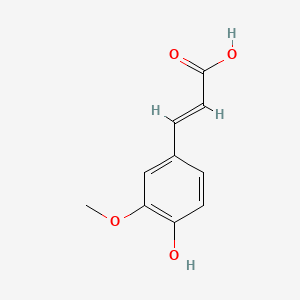
(E)-3-(4-hydroxy-3-methoxyphenyl)prop-2-enoic acid
References
- 1ISO 16128-1:2016 and ISO 16128-2:2017 — Guidelines on technical definitions and criteria for natural and organic cosmetic ingredients and products. ISO, Geneva.
- 2Ferulic Acid. PubChem CID 445858. National Center for Biotechnology Information. pubchem.ncbi.nlm.nih.gov ↗
- 3FERULIC ACID. CosIng — European Commission cosmetic ingredient database. ec.europa.eu/cosing ↗
- 4FERULIC ACID. CosIng u2014 European Commission database for information on cosmetic substances and ingredients. https://ec.europa.eu/growth/tools-databases/cosing/search?search=FERULIC%20ACID