How we scored it
Where it comes from
Assembled by solid-phase synthesis from fermentation-grade amino acids, then complexed with copper(II) salt. Protecting groups and coupling agents are process aids removed before the final peptide.
The industrial synthesis of Copper Tripeptide-1, also known as Glycyl-L-Histidyl-L-Lysine (GHK), is a complex process involving solid-phase or solution-phase peptide synthesis. The process begins with the sequential coupling of the three amino acids: glycine, histidine, and lysine. Each amino acid must be appropriately protected to prevent unwanted side reactions during peptide bond formation.
Common protecting groups, such as Boc (tert-butyloxycarbonyl) or Fmoc (9-fluorenylmethyloxycarbonyl) for the amine terminus, and various ester or ether groups for side chains (e.g., benzyl esters for lysine's carboxyl group), are employed. These protecting groups are typically synthesized from petrochemical precursors. The peptide bonds are formed using coupling reagents like DCC (dicyclohexylcarbodiimide), HOBt (hydroxybenzotriazole), or HATU (1-[Bis(dimethylamino)methylene]-1H-1,2,3-triazolo[4,5-b]pyridinium 3-oxid hexafluorophosphate), which are also derived from petrochemical sources.
Solid-phase peptide synthesis (SPPS) is a common industrial method. In SPPS, the C-terminal amino acid (lysine in this case) is attached to a solid resin support. Subsequent amino acids are added sequentially, with coupling and deprotection steps repeated until the desired peptide sequence is assembled. After the final amino acid is coupled, the peptide is cleaved from the resin, and all protecting groups are removed simultaneously under acidic conditions (e.g., using trifluoroacetic acid, TFA). Solution-phase synthesis can also be employed, particularly for larger-scale production, but involves similar protection, coupling, and deprotection strategies.
Following synthesis and deprotection, the crude peptide undergoes rigorous purification. This typically involves techniques such as reverse-phase high-performance liquid chromatography (RP-HPLC) to isolate the target peptide from unreacted starting materials, truncated sequences, and other byproducts. The purified peptide is then often converted to a salt form, such as the copper salt, by treatment with a copper source (e.g., copper sulfate or copper chloride) under controlled pH conditions. The final product is lyophilized to obtain a stable powder.
In plain English
Copper Tripeptide-1 is a tiny fragment of protein, three amino acids, bound to a copper ion. Your body makes the same molecule; in skincare it is used to support skin repair and firmness.
The amino acids come from fermenting sugar with bacteria, the way yoghurt or vitamin C are made, and the copper comes from a mineral salt. The chemistry used to join them is washed away before the ingredient is finished, so nothing petrochemical remains.
CosIng definition: Copper Tripeptide-1 is a copper complex of Tripeptide-1
Structure
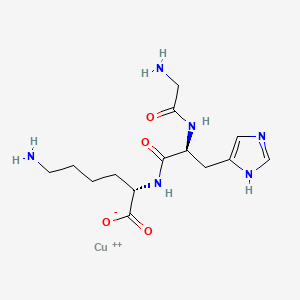
copper (2S)-6-amino-2-[[(2S)-2-[(2-aminoacetyl)amino]-3-(1H-imidazol-5-yl)propanoyl]amino]hexanoate
References
- 1ISO 16128-1:2016 and ISO 16128-2:2017 — Guidelines on technical definitions and criteria for natural and organic cosmetic ingredients and products. ISO, Geneva.
- 2Copper Tripeptide-1. PubChem CID 71587328. National Center for Biotechnology Information. pubchem.ncbi.nlm.nih.gov ↗
- 3COPPER TRIPEPTIDE-1. CosIng — European Commission cosmetic ingredient database. ec.europa.eu/cosing ↗
- 4COPPER TRIPEPTIDE-1. CosIng u2014 European Commission database for information on cosmetic substances and ingredients. https://ec.europa.eu/growth/tools-databases/cosing/search?search=COPPER%20TRIPEPTIDE-1