How we scored it
Where it comes from
Fermentation-grade amino acids assembled by solid-phase synthesis, capped with acetic anhydride, which is typically petrochemical. Bio-based acetic acid would raise the value to 1.0.
Acetyl Hexapeptide-3 is produced using solid-phase peptide synthesis (SPPS), a method widely employed for creating peptides. The process begins with anchoring the C-terminal amino acid to a solid resin support, typically polystyrene cross-linked with divinylbenzene. This resin is insoluble in the solvents used during synthesis, allowing for easy removal of excess reagents and byproducts through filtration and washing.
The peptide chain is then elongated step-by-step. Each amino acid, protected at its N-terminus (commonly with a Fmoc or Boc group) and activated at its carboxyl group, is sequentially coupled to the growing peptide chain attached to the resin. The coupling reaction is facilitated by activating agents such as carbodiimides (e.g., DIC, DCC) in the presence of additives like HOBt or Oxyma Pure. After each coupling step, the N-terminal protecting group is removed (deprotection) using specific reagents (e.g., piperidine for Fmoc, TFA for Boc), preparing the N-terminus for the next amino acid addition.
This iterative cycle of deprotection, washing, coupling, and washing is repeated until the desired hexapeptide sequence is assembled. For Acetyl Hexapeptide-3, the sequence is N-Acetyl-Glu-Glu-Met-Gln-Arg-Arg-OH. The final step involves cleaving the completed peptide from the resin and simultaneously removing any side-chain protecting groups. This is typically achieved using a strong acid cocktail, most commonly trifluoroacetic acid (TFA), often with scavengers like triisopropylsilane (TIS) or water to capture reactive species generated during cleavage. The crude peptide is then precipitated, usually with cold diethyl ether, and purified.
Purification is a critical step to obtain a high-purity peptide suitable for cosmetic applications. Reverse-phase high-performance liquid chromatography (RP-HPLC) is the standard method for purifying synthetic peptides. This technique separates the target peptide from unreacted starting materials, deletion sequences, and other impurities based on their hydrophobicity. The purified peptide is then lyophilized to yield a stable, dry powder. The N-terminal acetylation is usually performed either on the resin-bound peptide before cleavage or on the purified peptide in solution.
In plain English
Acetyl Hexapeptide-3 is a synthetic peptide, meaning it's a small chain of amino acids designed to mimic a natural process in the skin. Think of it like a tiny, targeted messenger molecule. It's created in a laboratory through a precise chemical process called solid-phase peptide synthesis. This method involves building the peptide chain one amino acid at a time, attaching it to a special support material, and then carefully adding the next building block until the desired sequence is complete.
This ingredient is designed to target the mechanisms involved in facial expression lines. It's believed to work by interfering with the signaling pathways that cause muscles to contract, thus helping to relax the skin and reduce the appearance of wrinkles, particularly those caused by repeated facial movements. Because it's a synthetic peptide, its production relies on carefully controlled chemical reactions using purified components, ensuring consistency and purity for cosmetic use.
CosIng definition: Acetyl hexapeptide-8 is the synthetic peptide consisting of arginine, methionine, and acetylated glutamic acid residues
Natural alternatives with the same function
Adenosine is a naturally occurring compound found in all living cells, playing a vital role in energy transfer…
Aloe Barbadensis Leaf Juice 100% natural originAloe Barbadensis Leaf Juice, commonly known as aloe vera, comes directly from the thick, fleshy leaves of the…
Argan Oil 100% natural originArgan oil is a luxurious oil derived from the kernels of the Argan tree, which is primarily found…
Ascorbic Acid 100% natural originAscorbic acid is the scientific name for Vitamin C, a well-known antioxidant that plays a crucial role in…
Ascorbyl Glucoside 100% natural originAscorbyl Glucoside is a stabilized form of Vitamin C, a popular ingredient known for its antioxidant and skin-brightening…
Azelaic Acid 100% natural originAzelaic acid is a dicarboxylic acid that occurs naturally in wheat, rye, and barley. In cosmetics, it's often…
Structure
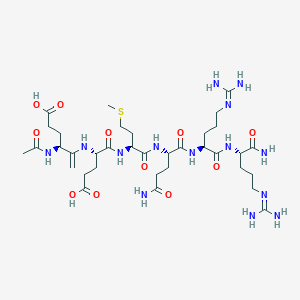
(4S)-4-acetamido-5-[[(2S)-1-[[(2S)-1-[[(2S)-5-amino-1-[[(2S)-1-[[(2S)-1-amino-5-(diaminomethylideneamino)-1-oxopentan-2-yl]amino]-5-(diaminomethylideneamino)-1-oxopentan-2-yl]amino]-1,5-dioxopentan-2-yl]amino]-4-methylsulfanyl-1-oxobutan-2-yl]amino]-4-carboxy-1-oxobutan-2-yl]amino]hex-5-enoic acid
References
- 1ISO 16128-1:2016 and ISO 16128-2:2017 — Guidelines on technical definitions and criteria for natural and organic cosmetic ingredients and products. ISO, Geneva.
- 2Acetyl Hexapeptide-3. PubChem CID 71587772. National Center for Biotechnology Information. pubchem.ncbi.nlm.nih.gov ↗
- 3ACETYL HEXAPEPTIDE-3. CosIng — European Commission cosmetic ingredient database. ec.europa.eu/cosing ↗
- 4ACETYL HEXAPEPTIDE-8. CosIng u2014 European Commission database for information on cosmetic substances and ingredients. https://ec.europa.eu/growth/tools-databases/cosing/search?search=ACETYL%20HEXAPEPTIDE-8