How we scored it
Where it comes from
Ascorbic acid from glucose plus a glucosyl unit transferred enzymatically from starch-derived dextrin. Fully carbohydrate-derived.
The industrial synthesis of Ascorbyl Glucoside involves the enzymatic or chemical glycosylation of Ascorbic Acid with Glucose. A common and preferred method utilizes enzymatic catalysis, often employing enzymes like alpha-glucosidase or cyclodextrin glucanotransferase. This biocatalytic approach offers high specificity and milder reaction conditions, typically performed in aqueous buffer systems at moderate temperatures (e.g., 40-60°C) and controlled pH.
The reaction aims to form an alpha-glycosidic bond between the C2 hydroxyl group of Ascorbic Acid and the C1 of Glucose. The enzyme facilitates the transfer of a glucosyl moiety from a donor (like maltodextrin or starch) to Ascorbic Acid. This method is favored for its efficiency and reduced formation of byproducts compared to purely chemical synthesis.
Alternatively, chemical synthesis can be employed, often involving the protection of reactive groups on Ascorbic Acid and Glucose, followed by a coupling reaction in the presence of a catalyst (e.g., Lewis acids) and subsequent deprotection steps. However, chemical routes can be less selective, potentially leading to a mixture of isomers and requiring more rigorous purification.
Following the reaction, the crude Ascorbyl Glucoside is purified through a series of steps. These typically include filtration to remove insoluble materials, decolorization using activated carbon, ion exchange chromatography to remove salts and charged impurities, and crystallization or precipitation to isolate the final product. The purity is assessed using techniques like HPLC to ensure it meets cosmetic grade specifications.
In plain English
Ascorbyl Glucoside is a stabilized form of Vitamin C, a popular ingredient known for its antioxidant and skin-brightening properties. It's created by combining Vitamin C (ascorbic acid) with glucose, a type of sugar. This combination makes the Vitamin C more stable, meaning it's less likely to break down when exposed to air or light, and it can be more effectively delivered into the skin.
Structure
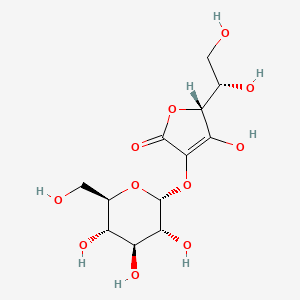
(2R)-2-[(1S)-1,2-dihydroxyethyl]-3-hydroxy-4-[(2R,3R,4S,5S,6R)-3,4,5-trihydroxy-6-(hydroxymethyl)oxan-2-yl]oxy-2H-furan-5-one
References
- 1ISO 16128-1:2016 and ISO 16128-2:2017 — Guidelines on technical definitions and criteria for natural and organic cosmetic ingredients and products. ISO, Geneva.
- 2Ascorbyl Glucoside. PubChem CID 54693473. National Center for Biotechnology Information. pubchem.ncbi.nlm.nih.gov ↗
- 3ASCORBYL GLUCOSIDE. CosIng — European Commission cosmetic ingredient database. ec.europa.eu/cosing ↗
- 4ASCORBYL GLUCOSIDE. CosIng u2014 European Commission database for information on cosmetic substances and ingredients. https://ec.europa.eu/growth/tools-databases/cosing/search?search=ASCORBYL%20GLUCOSIDE