How we scored it
Where it comes from
Dominant commercial route hydrogenates petrochemical p-toluic acid to 4-methylcyclohexanecarboxylic acid, then installs the aminomethyl group by bromination and amination (Delepine-type chemistry) with trans-isomerization. No bio-based alternative route is used commercially.
The industrial synthesis of Tranexamic Acid (trans-4-(aminomethyl)cyclohexanecarboxylic acid) typically begins with the hydrogenation of terephthalic acid or its derivatives, followed by amination. A common route involves the catalytic hydrogenation of terephthalic acid to cyclohexane-1,4-dicarboxylic acid. This intermediate is then converted to the diamide, which is subsequently dehydrated to the dinitrile. The dinitrile undergoes further reduction and hydrolysis steps to yield the desired trans isomer of 4-aminomethylcyclohexanecarboxylic acid.
Alternatively, synthesis can proceed from p-toluic acid. This involves oxidation to terephthalic acid, followed by a series of reactions including esterification, reduction, and amination. Another significant pathway starts with the reduction of 4-cyanobenzoic acid to 4-(aminomethyl)benzoic acid, which is then hydrogenated to produce Tranexamic Acid. The hydrogenation steps often employ catalysts such as palladium on carbon (Pd/C) or rhodium-based catalysts under elevated hydrogen pressure and temperature.
Purification is a critical step to obtain cosmetic-grade Tranexamic Acid. This typically involves recrystallization from suitable solvents, such as water or aqueous alcohol mixtures, to remove impurities and ensure the desired stereochemistry (trans isomer). Ion-exchange chromatography may also be employed for further purification. The final product is usually obtained as a white crystalline powder.
In plain English
Tranexamic Acid is a synthetic ingredient widely used in skincare for its remarkable ability to address hyperpigmentation and improve skin tone. It works by interfering with the pathway that leads to the overproduction of melanin, the pigment responsible for dark spots and uneven skin color. By inhibiting this process, it helps to visibly fade existing dark spots and prevent new ones from forming, leading to a brighter and more uniform complexion.
While it is a synthetic molecule, its structure is inspired by the amino acid lysine. It is produced through complex chemical processes that start with basic building blocks derived from petroleum. These processes involve multiple steps of chemical reactions, including hydrogenation and amination, to construct the precise molecular structure of Tranexamic Acid. Rigorous purification ensures its safety and efficacy for topical application.
Natural alternatives with the same function
Adenosine is a naturally occurring compound found in all living cells, playing a vital role in energy transfer…
Aloe Barbadensis Leaf Juice 100% natural originAloe Barbadensis Leaf Juice, commonly known as aloe vera, comes directly from the thick, fleshy leaves of the…
Argan Oil 100% natural originArgan oil is a luxurious oil derived from the kernels of the Argan tree, which is primarily found…
Ascorbic Acid 100% natural originAscorbic acid is the scientific name for Vitamin C, a well-known antioxidant that plays a crucial role in…
Ascorbyl Glucoside 100% natural originAscorbyl Glucoside is a stabilized form of Vitamin C, a popular ingredient known for its antioxidant and skin-brightening…
Azelaic Acid 100% natural originAzelaic acid is a dicarboxylic acid that occurs naturally in wheat, rye, and barley. In cosmetics, it's often…
Structure
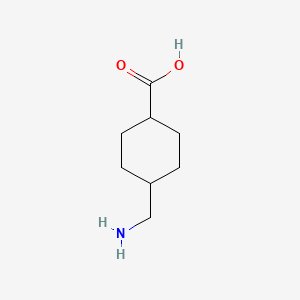
4-(aminomethyl)cyclohexane-1-carboxylic acid
References
- 1ISO 16128-1:2016 and ISO 16128-2:2017 — Guidelines on technical definitions and criteria for natural and organic cosmetic ingredients and products. ISO, Geneva.
- 2Tranexamic Acid. PubChem CID 5526. National Center for Biotechnology Information. pubchem.ncbi.nlm.nih.gov ↗
- 3TRANEXAMIC ACID. CosIng — European Commission cosmetic ingredient database. ec.europa.eu/cosing ↗
- 4TRANEXAMIC ACID. CosIng u2014 European Commission database for information on cosmetic substances and ingredients. https://ec.europa.eu/growth/tools-databases/cosing/search?search=TRANEXAMIC%20ACID