Why the score varies
This ingredient is made commercially by more than one route, and ISO 16128 scores the feedstock actually used. Without a supplier certificate of origin the value cannot be claimed.
| Route | Feedstock | NOI | Share | Notes |
|---|---|---|---|---|
| Extraction from thyme or ajwain essential oil | Thymus vulgaris or Trachyspermum ammi essential oil | 1.00 | ~30% | |
| Synthesis from m-cresol and propylene (Friedel-Crafts alkylation) | petrochemical m-cresol + propylene | 0.00 | ~70% |
How we scored it
How it’s made
Where it comes from
Bulk and oral-care-grade thymol is generally synthesised from m-cresol and propylene via Friedel-Crafts alkylation, a petrochemical route. A smaller natural-origin supply is extracted from thyme or ajwain (Trachyspermum ammi) essential oil.
In plain English
A phenol found in thyme oil, used as a fragrance and in oral-care products for its herbal scent. Some supply is extracted from thyme or ajwain oil; most bulk material is made synthetically from petrochemical building blocks.
CosIng definition: Thymol is the substituted phenol that conforms to the formula:
Natural alternatives with the same function
A sweet, licorice-like fragrance and flavour ingredient, the main component of anise and star anise oil. It is…
Boric Acid 100% natural originA mild mineral acid mined from natural borate deposits or brine. Used in small amounts to buffer pH,…
Brucine Sulfate 100% natural originThe sulfate salt of brucine, a bitter plant alkaloid extracted from Strychnos nux-vomica seeds, used in tiny amounts…
Camphor 100% natural originA cooling, sharp-scented ingredient traditionally distilled from camphor tree wood, though most today is made from pine tree…
Carapa Guaianensis Seed Oil 100% natural originA vegetable oil pressed from andiroba tree seeds, used to condition skin. Produced simply by pressing the oil…
Carapa Guianensis Seed Oil 100% natural originA conditioning oil pressed from the seeds of the Amazonian andiroba tree, used to soften skin in balms…
Structure
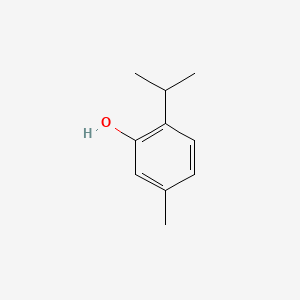
5-methyl-2-propan-2-ylphenol
References
- 1ISO 16128-1:2016 and ISO 16128-2:2017 — Guidelines on technical definitions and criteria for natural and organic cosmetic ingredients and products. ISO, Geneva.
- 2Thymol. PubChem CID 6989. National Center for Biotechnology Information. pubchem.ncbi.nlm.nih.gov ↗
- 3THYMOL. CosIng — European Commission cosmetic ingredient database. ec.europa.eu/cosing ↗
- 4THYMOL. CosIng u2014 European Commission database for information on cosmetic substances and ingredients. https://ec.europa.eu/growth/tools-databases/cosing/search?search=THYMOL