Why the score varies
This ingredient is made commercially by more than one route, and ISO 16128 scores the feedstock actually used. Without a supplier certificate of origin the value cannot be claimed.
| Route | Feedstock | NOI | Share | Notes |
|---|---|---|---|---|
| Fermentation / protein hydrolysate | Plant sugars or hydrolysed protein (soy, gelatin) | 1.00 | ~35% | |
| Chemical synthesis | Petrochemical chloroacetic acid + ammonia, or Strecker synthesis | 0.00 | ~65%, dominant for bulk supply |
How we scored it
Where it comes from
Bulk glycine is often made by reacting petrochemical chloroacetic acid with ammonia, or via Strecker synthesis. Some supply comes from fermentation or hydrolysed plant/animal protein.
In plain English
The simplest amino acid, used for moisturising and conditioning. It can come from fermented plant sugars or hydrolysed protein, but much of the world's supply is made by chemical synthesis instead.
Natural alternatives with the same function
An extract of lemon aspen, an Australian native fruit, used to condition skin and hair and help hold…
Alanine 100% natural originAn amino acid used for skin and hair conditioning, part of skin's natural moisturising factor. Made by fermenting…
Arginine 100% natural originAn amino acid found in skin and hair proteins, used for conditioning and moisture-binding. Made by fermenting plant…
Asparagine 100% natural originAn amino acid made by fermenting plant sugars, similar to other food-fermentation processes. Helps condition hair and skin…
Aspartic Acid 100% natural originAn amino acid used for skin conditioning and moisture retention. Usually produced by fermentation or by an enzyme…
Capryloyl Hydrolyzed Collagen 100% natural originCollagen broken into small protein fragments and attached to caprylic acid, an eight-carbon fatty acid from coconut or…
Structure
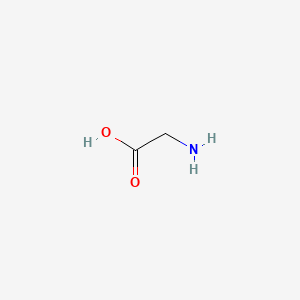
2-aminoacetic acid
References
- 1ISO 16128-1:2016 and ISO 16128-2:2017 — Guidelines on technical definitions and criteria for natural and organic cosmetic ingredients and products. ISO, Geneva.
- 2Glycine. PubChem CID 750. National Center for Biotechnology Information. pubchem.ncbi.nlm.nih.gov ↗
- 3GLYCINE. CosIng — European Commission cosmetic ingredient database. ec.europa.eu/cosing ↗
- 4GLYCINE. CosIng u2014 European Commission database for information on cosmetic substances and ingredients. https://ec.europa.eu/growth/tools-databases/cosing/search?search=GLYCINE