How we scored it
How it’s made
Where it comes from
Synthetic retinol from acetone-derived beta-ionone (BASF or DSM) esterified with palm-derived palmitic acid.
The industrial synthesis of Retinyl Palmitate primarily involves the esterification of retinol with palmitic acid. Retinol itself is typically synthesized via a complex multi-step process. A common route begins with the cyclization of isoprene units, followed by various functional group transformations. For example, citral can be synthesized from petrochemical sources and then converted to retinol through a series of reactions including Grignard additions and oxidations. Alternatively, retinol can be synthesized from beta-ionone, which is also derived from petrochemical feedstocks.
Palmitic acid, a saturated fatty acid, can be obtained from natural sources like palm oil or coconut oil through hydrolysis and subsequent purification. However, for cosmetic-grade Retinyl Palmitate, it is often synthesized or purified from sources that are integrated with petrochemical supply chains to ensure consistency and purity. The esterification reaction between retinol and palmitic acid is typically carried out under mild conditions, often in the presence of an acid catalyst (like sulfuric acid or p-toluenesulfonic acid) or a dehydrating agent, at moderate temperatures (e.g., 50-100°C) to drive the reaction to completion and remove water as a byproduct.
Purification of the resulting Retinyl Palmitate is crucial. This usually involves steps such as washing to remove residual acids and catalysts, followed by crystallization from suitable solvents (like ethanol or hexane) to obtain a high-purity product. Techniques like chromatography may also be employed for further refinement. The final product is typically a pale yellow, viscous liquid or crystalline solid, sensitive to light, air, and heat, necessitating careful handling and storage.
In plain English
Retinyl Palmitate is a form of Vitamin A, often called a "pro-vitamin" because your body can convert it into retinol, which is the active form of Vitamin A that benefits the skin. It's commonly found in skincare products like anti-aging creams and serums. Vitamin A is known for its ability to help promote skin cell turnover, which can lead to smoother, more radiant skin, and it also plays a role in supporting collagen production, helping to reduce the appearance of fine lines and wrinkles.
In terms of its origin, Retinyl Palmitate is typically made through a chemical process. While one of its components, palmitic acid, can be derived from plant oils, the other key component, retinol, is usually synthesized from petroleum-based chemicals. This means that the overall ingredient is considered to be derived from non-renewable, petroleum sources. It's valued for its stability and gentler action compared to other forms of Vitamin A, making it a popular choice for many cosmetic formulations.
CosIng definition: Retinyl Palmitate is the ester of Retinol and palmitic acid.
Natural alternatives with the same function
Adenosine is a naturally occurring compound found in all living cells, playing a vital role in energy transfer…
Aloe Barbadensis Leaf Juice 100% natural originAloe Barbadensis Leaf Juice, commonly known as aloe vera, comes directly from the thick, fleshy leaves of the…
Argan Oil 100% natural originArgan oil is a luxurious oil derived from the kernels of the Argan tree, which is primarily found…
Ascorbic Acid 100% natural originAscorbic acid is the scientific name for Vitamin C, a well-known antioxidant that plays a crucial role in…
Ascorbyl Glucoside 100% natural originAscorbyl Glucoside is a stabilized form of Vitamin C, a popular ingredient known for its antioxidant and skin-brightening…
Azelaic Acid 100% natural originAzelaic acid is a dicarboxylic acid that occurs naturally in wheat, rye, and barley. In cosmetics, it's often…
Structure
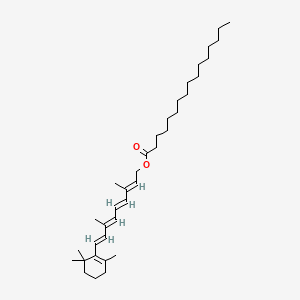
[(2E,4E,6E,8E)-3,7-dimethyl-9-(2,6,6-trimethylcyclohexen-1-yl)nona-2,4,6,8-tetraenyl] hexadecanoate
References
- 1ISO 16128-1:2016 and ISO 16128-2:2017 — Guidelines on technical definitions and criteria for natural and organic cosmetic ingredients and products. ISO, Geneva.
- 2Retinyl Palmitate. PubChem CID 5280531. National Center for Biotechnology Information. pubchem.ncbi.nlm.nih.gov ↗
- 3RETINYL PALMITATE. CosIng — European Commission cosmetic ingredient database. ec.europa.eu/cosing ↗
- 4RETINYL PALMITATE. CosIng u2014 European Commission database for information on cosmetic substances and ingredients. https://ec.europa.eu/growth/tools-databases/cosing/search?search=RETINYL%20PALMITATE