Why the score varies
This ingredient is made commercially by more than one route, and ISO 16128 scores the feedstock actually used. Without a supplier certificate of origin the value cannot be claimed.
| Route | Feedstock | NOI | Share | Notes |
|---|---|---|---|---|
| Synthetic aldol condensation | petrochemical aldehydes | 0.00 | ~70%, dominant | |
| Natural enzymatic conversion | plant linolenic/linoleic acid | 1.00 | ~30% |
Ask your supplier. A batch-specific certificate of origin or bio-based carbon test (ASTM D6866) settles which route applies.
How we scored it
Synthetic aldol-condensation route from petrochemical feedstocks gives 0.0 (larger commercial source); natural enzymatic route from plant leaf lipids gives 1.0 (minor alternative). Not averaged. Headline shows the best route (1.00), as for every route-dependent entry on the site.
What counts. ISO 16128-2 scores the atoms that remain in the final ingredient. Reagents, solvents, catalysts and protecting groups used during manufacture leave no mass behind and are not counted.
Where it comes from
Most commercial trans-2-hexenal is synthesised from petrochemical aldehydes. A natural route exists via lipoxygenase conversion of plant linolenic/linoleic acid, used for natural-origin claims.
In plain English
A green, leafy-smelling fragrance ingredient found naturally in plants and also made by chemical synthesis.
Structure
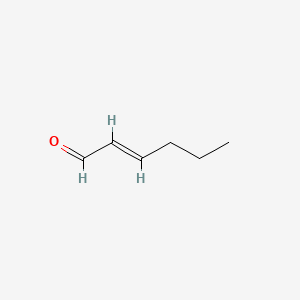
(E)-hex-2-enal
References
- 1ISO 16128-1:2016 and ISO 16128-2:2017 — Guidelines on technical definitions and criteria for natural and organic cosmetic ingredients and products. ISO, Geneva.
- 2Trans-2-Hexenal. PubChem CID 5281168. National Center for Biotechnology Information. pubchem.ncbi.nlm.nih.gov ↗
- 3TRANS-2-HEXENAL. CosIng — European Commission cosmetic ingredient database. ec.europa.eu/cosing ↗
- 4trans-2-hexenal. CosIng u2014 European Commission database for information on cosmetic substances and ingredients. https://ec.europa.eu/growth/tools-databases/cosing/search?search=trans-2-hexenal