How we scored it
C16H28O 236.39 Da (ambroxide): all 16 carbons come from sclareol of clary sage or fermentation-derived homofarnesol; oxidants and hydrides leave no mass. 236.39 / 236.39 = 1.00.
What counts. ISO 16128-2 scores the atoms that remain in the final ingredient. Reagents, solvents, catalysts and protecting groups used during manufacture leave no mass behind and are not counted.
Where it comes from
Dominant route degrades sclareol from clary sage (Salvia sclarea) to sclareolide, reduces it to a diol and cyclises it to ambroxide; a fermentation route via sugarcane farnesene and homofarnesol is also used. Fully petrochemical syntheses from small terpenoid blocks are uncommon.
In plain English
A woody, amber-smelling fragrance molecule (ambroxide) that gives perfumes warmth and long-lasting depth. It is most often made from sclareol, a compound extracted from clary sage, or by fermentation of sugar. It is used in place of ambergris, a rare material from sperm whales.
Structure
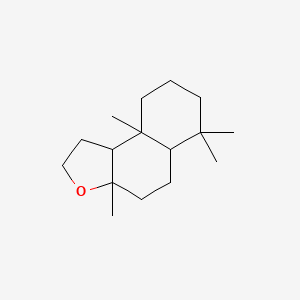
3a,6,6,9a-tetramethyl-2,4,5,5a,7,8,9,9b-octahydro-1H-benzo[e][1]benzofuran
References
- 1ISO 16128-1:2016 and ISO 16128-2:2017 — Guidelines on technical definitions and criteria for natural and organic cosmetic ingredients and products. ISO, Geneva.
- 2Dodecahydro-Tetramethylnaphthofuran. PubChem CID 107166. National Center for Biotechnology Information. pubchem.ncbi.nlm.nih.gov ↗
- 3DODECAHYDRO-TETRAMETHYLNAPHTHOFURAN. CosIng — European Commission cosmetic ingredient database. ec.europa.eu/cosing ↗
- 4DODECAHYDRO-TETRAMETHYLNAPHTHOFURAN. CosIng u2014 European Commission database for information on cosmetic substances and ingredients. https://ec.europa.eu/growth/tools-databases/cosing/search?search=DODECAHYDRO-TETRAMETHYLNAPHTHOFURAN