How we scored it
Where it comes from
Microbial fermentation of glucose or molasses (Kaneka and Chinese producers). A minor route condenses tobacco solanesol with a synthetic quinone.
The industrial synthesis of Coenzyme Q10 (CoQ10), also known as ubiquinone, is a complex multi-step process that predominantly relies on petrochemical feedstocks. A common starting point involves the synthesis of a substituted benzoquinone ring, often derived from benzene or toluene derivatives. This ring is then functionalized with a polyisoprenoid side chain, which is crucial for its biological activity.
The synthesis of the benzoquinone core typically involves reactions such as nitration, reduction, and oxidation. For instance, starting from p-cresol (derived from toluene), a series of reactions including formylation, oxidation, and methylation can lead to the desired 2,3-dimethoxy-5-methylbenzoquinone intermediate. The polyisoprenoid side chain, usually a C50 isoprenoid unit (geranylgeranyl pyrophosphate precursor), is synthesized separately, often through complex organic chemistry routes starting from isoprene or related petrochemical building blocks.
The final key step involves the coupling of the benzoquinone head group with the polyisoprenoid tail. This is typically achieved through a Friedel-Crafts-type alkylation or a related condensation reaction. The reaction conditions, including the choice of catalyst (e.g., Lewis acids like AlCl3 or BF3), solvent, and temperature, are carefully controlled to maximize yield and regioselectivity. Following the coupling, further modifications such as oxidation or methylation might be necessary to arrive at the final ubiquinone structure.
Purification of the synthesized CoQ10 is a critical stage to remove unreacted starting materials, byproducts, and residual catalysts. This often involves a combination of techniques such as crystallization, chromatography (e.g., silica gel chromatography), and solvent extraction. The purity of the final product is paramount for its use in cosmetic and pharmaceutical applications, with stringent quality control measures employed to ensure the absence of impurities.
In plain English
Coenzyme Q10, often called CoQ10 or ubiquinone, is a vitamin-like substance naturally found in our bodies, playing a vital role in energy production within cells and acting as a powerful antioxidant. In skincare, it's prized for its ability to help protect the skin from environmental damage caused by free radicals, which contribute to premature aging. It's also thought to support the skin's natural regenerative processes and can help improve the appearance of fine lines and wrinkles.
CosIng definition: Ubiquinone is the organic compound that conforms to the formula (Coenzyme Q-10)
Structure
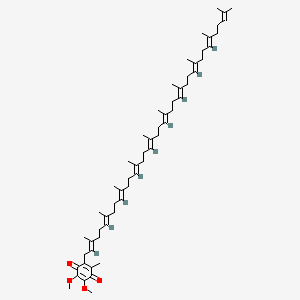
2-[(2E,6E,10E,14E,18E,22E,26E,30E,34E)-3,7,11,15,19,23,27,31,35,39-decamethyltetraconta-2,6,10,14,18,22,26,30,34,38-decaenyl]-5,6-dimethoxy-3-methylcyclohexa-2,5-diene-1,4-dione
References
- 1ISO 16128-1:2016 and ISO 16128-2:2017 — Guidelines on technical definitions and criteria for natural and organic cosmetic ingredients and products. ISO, Geneva.
- 2Coenzyme Q10. PubChem CID 5281915. National Center for Biotechnology Information. pubchem.ncbi.nlm.nih.gov ↗
- 3COENZYME Q10. CosIng — European Commission cosmetic ingredient database. ec.europa.eu/cosing ↗
- 4UBIQUINONE. CosIng u2014 European Commission database for information on cosmetic substances and ingredients. https://ec.europa.eu/growth/tools-databases/cosing/search?search=UBIQUINONE