How we scored it
Where it comes from
Ilmenite or rutile ore processed via the sulfate or chloride route, then coated with mineral oxides (alumina, silica). Organic coatings such as dimethicone are separate INCI entries.
The industrial production of titanium dioxide primarily follows two main processes: the sulfate process and the chloride process. Both processes aim to convert titanium-bearing ores into highly pure titanium dioxide pigment.
The sulfate process typically starts with ilmenite ore (FeTiO3). The ore is digested with concentrated sulfuric acid (H2SO4) at elevated temperatures (around 160-180°C) to form titanyl sulfate (TiOSO4) and iron sulfates. This reaction is exothermic and requires careful control. The resulting solution is then clarified, and iron is often reduced to ferrous sulfate (FeSO4) before being removed. The titanyl sulfate solution is hydrolyzed by heating, often with seeding, to precipitate hydrated titanium dioxide (TiO2·nH2O). This precipitate is then washed, calcined at high temperatures (800-1000°C) in rotary kilns, and milled to achieve the desired particle size and crystal structure (anatase or rutile).
The chloride process, which is generally preferred for producing rutile pigment due to its higher efficiency and cleaner operation, typically uses rutile ore or upgraded ilmenite. The ore is reacted with chlorine gas (Cl2) in the presence of a catalyst, such as petroleum coke, at high temperatures (around 900-1000°C) in a fluidised bed reactor. This produces titanium tetrachloride (TiCl4), which is a volatile liquid. Other metal chlorides, like iron chlorides, are also formed and are separated from TiCl4 by fractional distillation. The purified TiCl4 is then oxidized with oxygen or dry air at high temperatures (around 1000-1400°C) to produce fine titanium dioxide particles and regenerate chlorine gas, which is recycled. The resulting TiO2 is then cooled, collected, and often subjected to surface treatment with inorganic oxides (like alumina, silica, or zirconia) to improve its properties for specific applications, followed by milling.
Both processes involve significant chemical transformations and purification steps. The sulfate process uses sulfuric acid and generates substantial amounts of byproducts, including ferrous sulfate and acidic wastewater, requiring extensive waste treatment. The chloride process is more direct and energy-intensive but produces a purer product with fewer waste streams, though it requires handling highly corrosive chlorine gas and titanium tetrachloride. The final product is a highly pure inorganic pigment.
In plain English
Titanium dioxide is a naturally occurring mineral that is processed to become a white pigment. It's found in many everyday products, from paints and plastics to cosmetics and sunscreens. In cosmetics, it's prized for its ability to provide opacity, making products appear white or opaque, and for its effectiveness in blocking harmful ultraviolet (UV) rays from the sun, acting as a physical sunscreen agent.
To get titanium dioxide ready for use in cosmetics, the raw mineral is purified and processed through complex industrial methods. The most common ways involve either dissolving the mineral in strong acids and then precipitating and heating the resulting compound, or reacting it with chlorine gas at very high temperatures. These processes are designed to create very fine, pure particles of titanium dioxide that are safe and effective for cosmetic applications. The resulting white powder is then often treated on its surface to ensure it disperses well in cosmetic formulas and performs optimally as a colorant or UV filter.
Structure
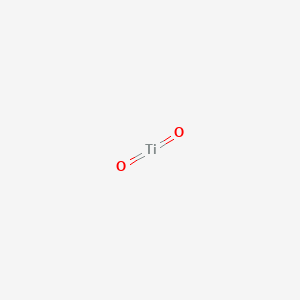
dioxotitanium
References
- 1ISO 16128-1:2016 and ISO 16128-2:2017 — Guidelines on technical definitions and criteria for natural and organic cosmetic ingredients and products. ISO, Geneva.
- 2Titanium Dioxide. PubChem CID 26042. National Center for Biotechnology Information. pubchem.ncbi.nlm.nih.gov ↗
- 3TITANIUM DIOXIDE. CosIng — European Commission cosmetic ingredient database. ec.europa.eu/cosing ↗
- 4Titanium Dioxide. CosIng u2014 European Commission database for information on cosmetic substances and ingredients. https://ec.europa.eu/growth/tools-databases/cosing/search?search=Titanium%20Dioxide