How we scored it
How it’s made
Where it comes from
Benzoic acid is manufactured by catalytic air oxidation of petrochemical toluene, then neutralized with sodium hydroxide to give sodium benzoate. Only the sodium ion counts as natural-origin mass.
The industrial synthesis of sodium benzoate typically begins with the production of benzoic acid. The most common method involves the liquid-phase air oxidation of toluene. This reaction is usually carried out at elevated temperatures (140-160 °C) and pressures (around 5-15 bar) in the presence of a metal catalyst, such as cobalt or manganese salts (e.g., cobalt naphthenate or manganese acetate).
The oxidation proceeds via a free-radical mechanism. Toluene is first converted to benzyl alcohol and benzaldehyde, which are further oxidized to benzoic acid. The reaction mixture is then cooled, and the benzoic acid is separated, often by crystallization or distillation, to achieve the required purity for cosmetic applications. Impurities can include unreacted toluene, benzaldehyde, and other oxidation byproducts.
Following purification, the benzoic acid is neutralized with a sodium base, typically sodium hydroxide (NaOH) or sodium carbonate (Na2CO3), in an aqueous solution. This neutralization reaction is straightforward acid-base chemistry, forming sodium benzoate and water. The reaction is exothermic and usually performed under controlled temperature conditions to prevent degradation. The resulting sodium benzoate solution is then concentrated, often by evaporation, and dried to obtain the solid product, which can be in crystalline or powder form.
In plain English
Sodium benzoate is a common ingredient used in cosmetics and personal care products primarily as a preservative. Its main job is to prevent the growth of bacteria, yeasts, and molds, which helps to keep your products safe and extends their shelf life. You'll often find it in water-based products like shampoos, lotions, and liquid soaps.
CosIng definition: Sodium Benzoate is the sodium salt of benzoic acid that conforms to the formula:
Natural alternatives with the same function
The calcium salt of a fatty acid derived from castor oil. Used to help control microbial growth and…
Ethyl Lauroyl Arginate HCl 100% natural originA preservative and conditioning ingredient built from an amino acid, coconut fatty acid, and alcohol. Used in cosmetics…
Lactobacillus/Radish Root Ferment Filtrate 100% natural originRadish root that has been fermented by Lactobacillus, the lactic acid bacteria also used in yoghurt and pickles,…
Monarda Fistulosa Extract 100% natural originAn extract made from the whole wild bergamot plant, a mint-family herb. Used for its scent and preservative-boosting…
Murraya Koenigii Leaf Oil 100% natural originThe aromatic oil steam-distilled from curry leaves (Murraya koenigii). It is listed with a preservative function. It is…
Nobiletin 100% natural originA natural antioxidant extracted from citrus peel, particularly Okinawan shiikuwasa and tangerine. Used in skincare to help protect…
Structure
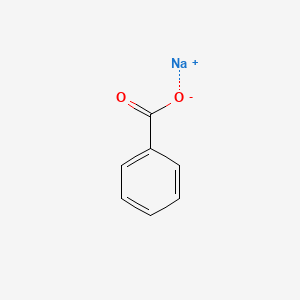
sodium benzoate
References
- 1ISO 16128-1:2016 and ISO 16128-2:2017 — Guidelines on technical definitions and criteria for natural and organic cosmetic ingredients and products. ISO, Geneva.
- 2Sodium Benzoate. PubChem CID 517055. National Center for Biotechnology Information. pubchem.ncbi.nlm.nih.gov ↗
- 3SODIUM BENZOATE. CosIng — European Commission cosmetic ingredient database. ec.europa.eu/cosing ↗
- 4SODIUM BENZOATE. CosIng u2014 European Commission database for information on cosmetic substances and ingredients. https://ec.europa.eu/growth/tools-databases/cosing/search?search=SODIUM%20BENZOATE