How we scored it
How it’s made
Where it comes from
Manufactured by esterifying p-hydroxybenzoic acid (from petrochemical phenol via Kolbe-Schmitt carboxylation) with petrochemical n-propanol. No commercially significant natural route exists for cosmetic-grade propylparaben.
The industrial synthesis of propylparaben (propyl p-hydroxybenzoate) is a well-established esterification process. The primary route involves the reaction of p-hydroxybenzoic acid with n-propanol.
p-Hydroxybenzoic acid itself is commonly synthesized via the Kolbe-Schmitt reaction. This process involves the carboxylation of sodium phenoxide (derived from phenol, a petrochemical) with carbon dioxide under elevated temperature and pressure (typically 120-180°C and several atmospheres). The resulting sodium salicylate is then isomerized to sodium p-hydroxybenzoate, which is subsequently acidified to yield p-hydroxybenzoic acid.
Alternatively, p-hydroxybenzoic acid can be produced from toluene through oxidation and subsequent reactions, also originating from petrochemical sources. The esterification step to form propylparaben involves reacting the purified p-hydroxybenzoic acid with n-propanol. This reaction is typically catalyzed by a strong acid, such as sulfuric acid (H2SO4), and often carried out under reflux conditions to drive the equilibrium towards ester formation. Water, a byproduct of the esterification, is usually removed to maximize yield.
Following the esterification, the crude propylparaben is purified through methods such as recrystallization from suitable solvents (e.g., ethanol/water mixtures) or distillation to achieve the high purity required for cosmetic and pharmaceutical applications. The process is designed to remove unreacted starting materials, catalyst residues, and any side products.
In plain English
Propylparaben is a type of preservative commonly used in cosmetics and personal care products to prevent the growth of bacteria, yeasts, and molds. This helps to extend the shelf life of products and ensure they remain safe to use over time.
It belongs to a group of chemicals called parabens, which are esters of p-hydroxybenzoic acid. The 'propyl' part indicates that it is made by reacting p-hydroxybenzoic acid with an alcohol called propanol. Both of these starting materials are typically derived from petroleum, meaning propylparaben is considered a synthetic ingredient with no natural origin.
CosIng definition: Propylparaben is the ester of n-propyl alcohol and p-hydroxybenzoic acid. It conforms to the formula:
Natural alternatives with the same function
The calcium salt of a fatty acid derived from castor oil. Used to help control microbial growth and…
Ethyl Lauroyl Arginate HCl 100% natural originA preservative and conditioning ingredient built from an amino acid, coconut fatty acid, and alcohol. Used in cosmetics…
Lactobacillus/Radish Root Ferment Filtrate 100% natural originRadish root that has been fermented by Lactobacillus, the lactic acid bacteria also used in yoghurt and pickles,…
Monarda Fistulosa Extract 100% natural originAn extract made from the whole wild bergamot plant, a mint-family herb. Used for its scent and preservative-boosting…
Murraya Koenigii Leaf Oil 100% natural originThe aromatic oil steam-distilled from curry leaves (Murraya koenigii). It is listed with a preservative function. It is…
Nobiletin 100% natural originA natural antioxidant extracted from citrus peel, particularly Okinawan shiikuwasa and tangerine. Used in skincare to help protect…
Structure
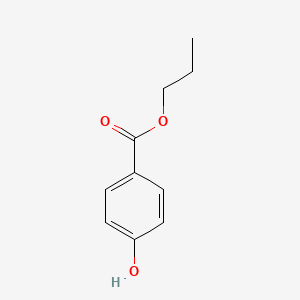
propyl 4-hydroxybenzoate
References
- 1ISO 16128-1:2016 and ISO 16128-2:2017 — Guidelines on technical definitions and criteria for natural and organic cosmetic ingredients and products. ISO, Geneva.
- 2Propylparaben. PubChem CID 7175. National Center for Biotechnology Information. pubchem.ncbi.nlm.nih.gov ↗
- 3PROPYLPARABEN. CosIng — European Commission cosmetic ingredient database. ec.europa.eu/cosing ↗
- 4PROPYLPARABEN. CosIng u2014 European Commission database for information on cosmetic substances and ingredients. https://ec.europa.eu/growth/tools-databases/cosing/search?search=PROPYLPARABEN