How we scored it
How it’s made
Where it comes from
Made by esterifying gallic acid, obtained by hydrolysing tannins from gallnuts or tara pods, with propanol, a petrochemical alcohol. The plant-derived acid supplies most of the molecule's mass.
In plain English
An antioxidant that helps protect oils and fragrances in cosmetics from going rancid. It is made by combining gallic acid, extracted from plant tannins such as gallnuts, with propanol, a synthetic alcohol.
Natural alternatives with the same function
A stabilised, water-soluble form of vitamin C used as an antioxidant and humectant in skincare. It is made…
Acacia Catechu Wood Extract 100% natural originAn extract of the heartwood of the black catechu tree, rich in plant polyphenols such as catechin. It…
Acer Palmatum Leaf Extract 100% natural originA plant extract from Japanese maple leaves, valued as an antioxidant. It's produced by simple extraction from the…
Achillea Millefolium Flower Extract 100% natural originAn extract made from yarrow flowers, a plant long used in traditional herbal preparations. Used to help condition…
Adenosine 100% natural originAdenosine is a naturally occurring compound found in all living cells, playing a vital role in energy transfer…
Aesculus Hippocastanum Extract 100% natural originAn extract from the horse chestnut tree, used to soothe and protect skin and tighten its surface feel.…
Structure
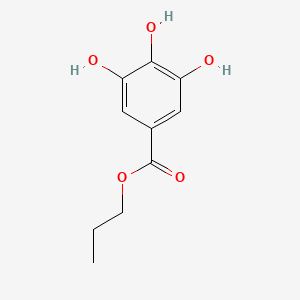
propyl 3,4,5-trihydroxybenzoate
References
- 1ISO 16128-1:2016 and ISO 16128-2:2017 — Guidelines on technical definitions and criteria for natural and organic cosmetic ingredients and products. ISO, Geneva.
- 2Propyl Gallate. PubChem CID 4947. National Center for Biotechnology Information. pubchem.ncbi.nlm.nih.gov ↗
- 3PROPYL GALLATE. CosIng — European Commission cosmetic ingredient database. ec.europa.eu/cosing ↗
- 4PROPYL GALLATE. CosIng u2014 European Commission database for information on cosmetic substances and ingredients. https://ec.europa.eu/growth/tools-databases/cosing/search?search=PROPYL%20GALLATE