How we scored it
How it’s made
Where it comes from
Manufactured by esterifying p-hydroxybenzoic acid, produced from petrochemical phenol via Kolbe-Schmitt carboxylation, with petrochemical methanol. No commercially significant natural route exists for cosmetic-grade methylparaben.
The industrial synthesis of methylparaben involves the esterification of p-hydroxybenzoic acid (PHBA) with methanol. This reaction is typically catalyzed by a strong acid, such as sulfuric acid (H2SO4).
The process begins with the preparation of p-hydroxybenzoic acid. While PHBA can be derived from natural sources, the predominant commercial route for its production starts with phenol. Phenol is reacted with carbon dioxide under pressure and elevated temperature (Kolbe-Schmitt reaction) to yield salicylic acid, which is then isomerized to p-hydroxybenzoic acid. Alternatively, phenol can be carboxylated directly under specific conditions.
Once p-hydroxybenzoic acid is obtained, it is reacted with methanol in the presence of an acid catalyst. The reaction is an equilibrium-limited esterification, and to drive the reaction towards the product, excess methanol is often used, or water is removed as it is formed. Typical reaction temperatures range from 100-150°C, depending on the specific process and catalyst employed.
Following the esterification, the crude methylparaben is purified. This usually involves neutralization of the acid catalyst, followed by steps such as crystallization from a suitable solvent (e.g., water or ethanol/water mixtures), washing, and drying. The purity requirements for cosmetic-grade methylparaben are stringent, necessitating efficient removal of unreacted starting materials, byproducts, and residual catalyst.
In plain English
Methylparaben is a common ingredient used in cosmetics and personal care products to prevent the growth of bacteria, yeast, and mold. Think of it as a preservative that helps keep your products safe and extends their shelf life, preventing them from spoiling before you can use them up.
It belongs to a group of preservatives called parabens. While effective, parabens have been a subject of discussion. The way methylparaben is made industrially involves chemical processes starting from basic building blocks derived from petroleum. These are then chemically transformed through several steps, including reacting a compound called p-hydroxybenzoic acid with methanol, using an acid catalyst to create the final methylparaben molecule.
CosIng definition: Methylparaben is the ester of methyl alcohol and p-hydroxybenzoic acid. It conforms to the formula:
Natural alternatives with the same function
The calcium salt of a fatty acid derived from castor oil. Used to help control microbial growth and…
Ethyl Lauroyl Arginate HCl 100% natural originA preservative and conditioning ingredient built from an amino acid, coconut fatty acid, and alcohol. Used in cosmetics…
Lactobacillus/Radish Root Ferment Filtrate 100% natural originRadish root that has been fermented by Lactobacillus, the lactic acid bacteria also used in yoghurt and pickles,…
Monarda Fistulosa Extract 100% natural originAn extract made from the whole wild bergamot plant, a mint-family herb. Used for its scent and preservative-boosting…
Murraya Koenigii Leaf Oil 100% natural originThe aromatic oil steam-distilled from curry leaves (Murraya koenigii). It is listed with a preservative function. It is…
Nobiletin 100% natural originA natural antioxidant extracted from citrus peel, particularly Okinawan shiikuwasa and tangerine. Used in skincare to help protect…
Structure
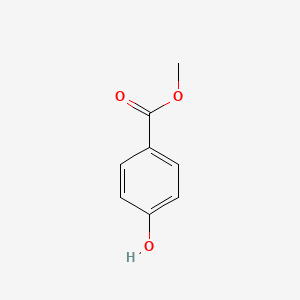
methyl 4-hydroxybenzoate
References
- 1ISO 16128-1:2016 and ISO 16128-2:2017 — Guidelines on technical definitions and criteria for natural and organic cosmetic ingredients and products. ISO, Geneva.
- 2Methylparaben. PubChem CID 7456. National Center for Biotechnology Information. pubchem.ncbi.nlm.nih.gov ↗
- 3METHYLPARABEN. CosIng — European Commission cosmetic ingredient database. ec.europa.eu/cosing ↗
- 4METHYLPARABEN. CosIng u2014 European Commission database for information on cosmetic substances and ingredients. https://ec.europa.eu/growth/tools-databases/cosing/search?search=METHYLPARABEN