How we scored it
How it’s made
Where it comes from
Manufactured by esterifying salicylic acid (from petrochemical phenol via Kolbe-Schmitt carboxylation) with 2-ethylhexanol (a petrochemical oxo-alcohol). No natural-origin route is used commercially for this UV filter.
The industrial synthesis of Octisalate (Octyl Salicylate or 2-Ethylhexyl Salicylate) involves the esterification of salicylic acid with 2-ethylhexanol. Salicylic acid is commonly manufactured via the Kolbe-Schmitt reaction, where sodium phenoxide (derived from phenol and sodium hydroxide) is carboxylated under pressure with carbon dioxide at elevated temperatures (around 125°C). The resulting sodium salicylate is then acidified to yield salicylic acid.
Phenol, the precursor to salicylic acid, is primarily produced through the cumene process. This involves the alkylation of benzene with propylene to form cumene, followed by the oxidation of cumene to cumene hydroperoxide, and finally the acid-catalyzed cleavage of cumene hydroperoxide to yield phenol and acetone. Benzene and propylene are both derived from crude oil refining or natural gas processing.
The second key reactant, 2-ethylhexanol, is typically synthesized via the oxo process (hydroformylation) starting from propylene. Propylene is reacted with synthesis gas (carbon monoxide and hydrogen) in the presence of a catalyst (often a rhodium or cobalt complex) to produce butyraldehyde. This is followed by aldol condensation of butyraldehyde to form 2-ethylhexenal, which is then hydrogenated to yield 2-ethylhexanol.
The final esterification step to produce Octisalate involves reacting salicylic acid with 2-ethylhexanol, usually in the presence of an acid catalyst such as sulfuric acid or p-toluenesulfonic acid. The reaction is typically carried out at elevated temperatures (e.g., 100-150°C) with removal of water to drive the equilibrium towards product formation. Purification of the crude Octisalate is achieved through methods like distillation or washing to remove unreacted starting materials, catalyst, and byproducts.
In plain English
Octisalate is a chemical compound commonly found in sunscreens and other personal care products designed to protect the skin from the sun's harmful ultraviolet (UV) rays. It functions as a UV-B filter, meaning it absorbs a specific range of UV radiation that can cause sunburn and contribute to skin aging and damage.
This ingredient is synthesized through a multi-step chemical process that begins with basic building blocks derived from petroleum. These petrochemical feedstocks are transformed through various chemical reactions, including esterification, to create the final Octisalate molecule. Because its production relies entirely on non-renewable fossil fuels, it is classified as having a 100% petroleum origin according to natural origin index standards.
CosIng definition: Ethylhexyl Salicylate is the ester of 2-ethylhexyl alcohol and salicylic acid. It conforms to the formula:
Natural alternatives with the same function
A plant extract from butterfly bush flowers, included in formulas partly for its natural UV-absorbing plant compounds. It…
Carthamus Tinctorius Leaf Extract 100% natural originAn extract from the leaves of the safflower plant, the species grown for safflower oil and flower dye.…
Phytoene 100% natural originA natural pigment-precursor from tomatoes or algae that helps protect skin from environmental and light stress. Used in…
Phytofluene 100% natural originA natural tomato- or algae-derived pigment precursor valued in skincare as an antioxidant that helps shield skin from…
Titanium Dioxide 100% natural originTitanium dioxide is a naturally occurring mineral that is processed to become a white pigment. It's found in…
Zinc Oxide 100% natural originZinc oxide is a white powder that's been used for centuries to protect and soothe the skin. In…
Structure
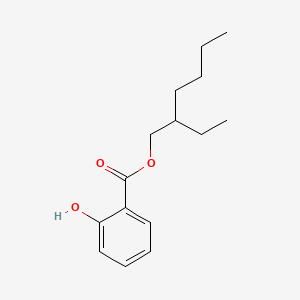
2-ethylhexyl 2-hydroxybenzoate
References
- 1ISO 16128-1:2016 and ISO 16128-2:2017 — Guidelines on technical definitions and criteria for natural and organic cosmetic ingredients and products. ISO, Geneva.
- 2Octisalate. PubChem CID 8364. National Center for Biotechnology Information. pubchem.ncbi.nlm.nih.gov ↗
- 3OCTISALATE. CosIng — European Commission cosmetic ingredient database. ec.europa.eu/cosing ↗
- 4ETHYLHEXYL SALICYLATE. CosIng u2014 European Commission database for information on cosmetic substances and ingredients. https://ec.europa.eu/growth/tools-databases/cosing/search?search=ETHYLHEXYL%20SALICYLATE