How we scored it
How it’s made
Where it comes from
Manufactured by esterifying 2-ethylhexanol (petrochemical oxo-alcohol from propylene) with 4-methoxycinnamic acid, made from petrochemical p-cresol/anisaldehyde. No natural-origin commercial route is used for this UV filter.
The industrial synthesis of Octinoxate (Ethylhexyl Methoxycinnamate) typically involves a two-step process starting from petrochemical feedstocks.
The first key intermediate is p-methoxycinnamic acid. This is commonly synthesized via the Perkin reaction or a related condensation reaction. A typical route involves the reaction of p-methoxybenzaldehyde with acetic anhydride in the presence of a base catalyst, such as sodium acetate or potassium acetate. The reaction is usually carried out at elevated temperatures, often in the range of 150-180°C, to drive the condensation and subsequent dehydration. Alternatively, p-methoxybenzaldehyde can be reacted with malonic acid in the presence of a base like pyridine and piperidine (Doebner modification of the Knoevenagel condensation), followed by decarboxylation.
The second step is the esterification of p-methoxycinnamic acid with 2-ethylhexanol. This reaction is typically catalyzed by a strong acid, such as sulfuric acid (H2SO4) or p-toluenesulfonic acid (p-TsOH). The reaction is usually performed under reflux conditions, often with azeotropic removal of water to shift the equilibrium towards ester formation. Temperatures can range from 100-150°C depending on the specific catalyst and solvent system used. The 2-ethylhexanol itself is synthesized from propylene, a petrochemical derivative, via the oxo process (hydroformylation) followed by aldol condensation and hydrogenation.
Following the esterification, the crude Octinoxate product undergoes purification. This typically involves neutralization of the acid catalyst, washing with water to remove salts and unreacted acid, and then distillation under reduced pressure to obtain the high-purity Octinoxate. The distillation process removes residual starting materials, byproducts, and any color bodies, ensuring the final product meets cosmetic grade specifications.
In plain English
Octinoxate, also known by its INCI name Ethylhexyl Methoxycinnamate, is a widely used ingredient in sunscreens and other cosmetic products designed to protect the skin from the sun's harmful ultraviolet (UV) rays. Its primary function is to absorb UVB radiation, which is a major cause of sunburn and contributes to skin aging and skin cancer.
Chemically, Octinoxate is a synthetic organic compound. Its production relies entirely on materials derived from petroleum. The manufacturing process involves several chemical reactions, starting with basic petrochemical building blocks. These are transformed through a series of steps, including condensation and esterification reactions, to create the final Octinoxate molecule. Because its synthesis begins with and relies exclusively on non-renewable fossil fuels, it is classified as 100% petroleum-derived under the ISO 16128 standard.
CosIng definition: Ethylhexyl Methoxycinnamate is the ester of 2-ethylhexyl alcohol and methoxycinnamic acid. It conforms to the formula
Natural alternatives with the same function
A plant extract from butterfly bush flowers, included in formulas partly for its natural UV-absorbing plant compounds. It…
Carthamus Tinctorius Leaf Extract 100% natural originAn extract from the leaves of the safflower plant, the species grown for safflower oil and flower dye.…
Phytoene 100% natural originA natural pigment-precursor from tomatoes or algae that helps protect skin from environmental and light stress. Used in…
Phytofluene 100% natural originA natural tomato- or algae-derived pigment precursor valued in skincare as an antioxidant that helps shield skin from…
Titanium Dioxide 100% natural originTitanium dioxide is a naturally occurring mineral that is processed to become a white pigment. It's found in…
Zinc Oxide 100% natural originZinc oxide is a white powder that's been used for centuries to protect and soothe the skin. In…
Structure
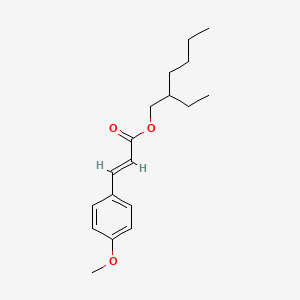
2-ethylhexyl (E)-3-(4-methoxyphenyl)prop-2-enoate
References
- 1ISO 16128-1:2016 and ISO 16128-2:2017 — Guidelines on technical definitions and criteria for natural and organic cosmetic ingredients and products. ISO, Geneva.
- 2Octinoxate. PubChem CID 5355130. National Center for Biotechnology Information. pubchem.ncbi.nlm.nih.gov ↗
- 3OCTINOXATE. CosIng — European Commission cosmetic ingredient database. ec.europa.eu/cosing ↗
- 4ETHYLHEXYL METHOXYCINNAMATE. CosIng u2014 European Commission database for information on cosmetic substances and ingredients. https://ec.europa.eu/growth/tools-databases/cosing/search?search=ETHYLHEXYL%20METHOXYCINNAMATE