How we scored it
Where it comes from
Manufactured by diazotization/coupling chemistry from petrochemical aromatic intermediates (nitro-benzotriazole, alkylphenols). No natural-origin commercial route exists for this synthetic UV chromophore.
Bisoctrizole, also known as Bis-Ethylhexyloxyphenol Methoxyphenyl Triazine, is a broad-spectrum UV filter synthesized through a multi-step chemical process. The synthesis typically begins with the preparation of key intermediates, often involving reactions like Friedel-Crafts acylation or alkylation on aromatic precursors derived from petrochemical sources.
One common synthetic pathway involves the reaction of 2,4,6-trichloro-1,3,5-triazine with phenol derivatives. The triazine ring is usually synthesized from hydrogen cyanide and chlorine, or from cyanuric chloride. The phenolic components are derived from benzene or toluene, which are petrochemical building blocks. These intermediates are then coupled through various condensation and substitution reactions.
Key reagents often include strong acids (like sulfuric acid or Lewis acids) as catalysts for acylation or alkylation steps, and bases (like sodium hydroxide or potassium carbonate) for deprotonation or neutralization. Solvents such as toluene, xylene, or chlorinated hydrocarbons are commonly employed. The reaction conditions can vary but often involve elevated temperatures (e.g., 50-150°C) and controlled pressure to optimize yield and purity.
Purification of the final Bisoctrizole product is crucial for its use in cosmetic applications. This typically involves multiple steps, including washing to remove inorganic salts and residual reagents, recrystallization from suitable organic solvents (like ethanol, isopropanol, or ethyl acetate) to achieve high purity, and drying under vacuum. Spectroscopic techniques (NMR, IR, UV-Vis) and chromatographic methods (HPLC) are used to confirm the structure and purity of the final product.
In plain English
Bisoctrizole is a type of sunscreen ingredient that works by absorbing a wide range of ultraviolet (UV) rays from the sun. It's designed to protect your skin from both UVA and UVB radiation, which can cause sunburn, premature aging, and increase the risk of skin cancer. It's a synthetic molecule, meaning it's created entirely through chemical processes in a laboratory, rather than being derived from natural sources like plants or animals.
This ingredient is valued for its excellent photostability, meaning it doesn't break down easily when exposed to sunlight. This allows it to provide long-lasting sun protection. It's often used in combination with other UV filters to create a comprehensive sunscreen formulation that offers robust defense against sun damage. Because it's a synthetic ingredient, its production relies on petrochemicals, which are derived from oil and natural gas.
CosIng definition: Methylene Bis-Benzotriazolyl Tetramethylbutylphenol is the heterocyclic compound that conforms to the formula:
Natural alternatives with the same function
A plant extract from butterfly bush flowers, included in formulas partly for its natural UV-absorbing plant compounds. It…
Carthamus Tinctorius Leaf Extract 100% natural originAn extract from the leaves of the safflower plant, the species grown for safflower oil and flower dye.…
Phytoene 100% natural originA natural pigment-precursor from tomatoes or algae that helps protect skin from environmental and light stress. Used in…
Phytofluene 100% natural originA natural tomato- or algae-derived pigment precursor valued in skincare as an antioxidant that helps shield skin from…
Titanium Dioxide 100% natural originTitanium dioxide is a naturally occurring mineral that is processed to become a white pigment. It's found in…
Zinc Oxide 100% natural originZinc oxide is a white powder that's been used for centuries to protect and soothe the skin. In…
Structure
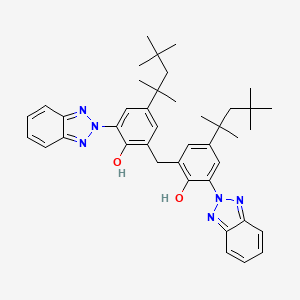
2-(benzotriazol-2-yl)-6-[[3-(benzotriazol-2-yl)-2-hydroxy-5-(2,4,4-trimethylpentan-2-yl)phenyl]methyl]-4-(2,4,4-trimethylpentan-2-yl)phenol
References
- 1ISO 16128-1:2016 and ISO 16128-2:2017 — Guidelines on technical definitions and criteria for natural and organic cosmetic ingredients and products. ISO, Geneva.
- 2Bisoctrizole. PubChem CID 3571576. National Center for Biotechnology Information. pubchem.ncbi.nlm.nih.gov ↗
- 3BISOCTRIZOLE. CosIng — European Commission cosmetic ingredient database. ec.europa.eu/cosing ↗
- 4METHYLENE BIS-BENZOTRIAZOLYL TETRAMETHYLBUTYLPHENOL. CosIng u2014 European Commission database for information on cosmetic substances and ingredients. https://ec.europa.eu/growth/tools-databases/cosing/search?search=METHYLENE%20BIS-BENZOTRIAZOLYL%20TETRAMETHYLBUTYLPHENOL