How we scored it
Where it comes from
Nearly all cosmetic-grade Retinol is produced by total synthesis from petrochemical beta-ionone via Wittig/aldol chemistry (BASF/DSM-type routes). No commercially significant natural-extraction route supplies cosmetic retinol volumes.
The industrial synthesis of retinol (Vitamin A) is a multi-step process that predominantly starts from petrochemical-derived precursors. A common pathway involves the synthesis of beta-ionone from citral and acetone, followed by a Wittig reaction or similar olefination to extend the carbon chain and introduce the necessary unsaturation. Beta-ionone itself can be synthesized from isoprene, a petrochemical building block.
Another significant route begins with cholesterol, which can be obtained from wool grease (lanolin) or synthesized from petrochemical sources. Cholesterol is then subjected to a series of chemical transformations, including oxidation and degradation, to yield a suitable intermediate like 7-dehydrocholesterol. This intermediate is then converted to retinol through various methods, such as photochemical conversion or chemical reduction and oxidation steps.
Key reagents in these syntheses can include strong bases like sodium amide or organolithium compounds for Wittig reactions, oxidizing agents such as manganese dioxide or pyridinium chlorochromate, and reducing agents like lithium aluminum hydride. Reaction conditions often require anhydrous environments, inert atmospheres (e.g., nitrogen or argon), and controlled temperatures, ranging from sub-zero to elevated temperatures depending on the specific step. Purification is critical and typically involves chromatography (e.g., column chromatography, HPLC) and crystallization to achieve the high purity required for cosmetic and pharmaceutical applications.
In plain English
Retinol, also known as Vitamin A, is a powerful ingredient widely used in skincare for its anti-aging and skin-renewing properties. It works by encouraging skin cell turnover and stimulating the production of collagen, which helps to reduce the appearance of fine lines, wrinkles, and uneven skin tone. It also acts as an antioxidant, protecting the skin from damage caused by free radicals.
In the cosmetic industry, retinol is produced through complex chemical synthesis processes. These processes typically start with basic chemical building blocks derived from petroleum. Through a series of carefully controlled reactions, these starting materials are transformed step-by-step into the final retinol molecule. The synthesis requires precise control over reaction conditions, including temperature and the use of specific chemical agents, to ensure the purity and efficacy of the final product.
CosIng definition: Retinol is the organic compound that conforms to the formula:
Natural alternatives with the same function
Adenosine is a naturally occurring compound found in all living cells, playing a vital role in energy transfer…
Aloe Barbadensis Leaf Juice 100% natural originAloe Barbadensis Leaf Juice, commonly known as aloe vera, comes directly from the thick, fleshy leaves of the…
Argan Oil 100% natural originArgan oil is a luxurious oil derived from the kernels of the Argan tree, which is primarily found…
Ascorbic Acid 100% natural originAscorbic acid is the scientific name for Vitamin C, a well-known antioxidant that plays a crucial role in…
Ascorbyl Glucoside 100% natural originAscorbyl Glucoside is a stabilized form of Vitamin C, a popular ingredient known for its antioxidant and skin-brightening…
Azelaic Acid 100% natural originAzelaic acid is a dicarboxylic acid that occurs naturally in wheat, rye, and barley. In cosmetics, it's often…
Structure
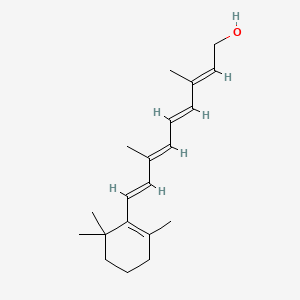
(2E,4E,6E,8E)-3,7-dimethyl-9-(2,6,6-trimethylcyclohexen-1-yl)nona-2,4,6,8-tetraen-1-ol
References
- 1ISO 16128-1:2016 and ISO 16128-2:2017 — Guidelines on technical definitions and criteria for natural and organic cosmetic ingredients and products. ISO, Geneva.
- 2Retinol. PubChem CID 445354. National Center for Biotechnology Information. pubchem.ncbi.nlm.nih.gov ↗
- 3RETINOL. CosIng — European Commission cosmetic ingredient database. ec.europa.eu/cosing ↗
- 4RETINOL. CosIng u2014 European Commission database for information on cosmetic substances and ingredients. https://ec.europa.eu/growth/tools-databases/cosing/search?search=RETINOL