How we scored it
How it’s made
Where it comes from
Synthetic: isobutyraldehyde and formaldehyde to pantolactone, resolved and condensed with 3-aminopropanol. Bio-based precursors are not used at commercial scale; the earlier route-dependent claim was unsupported.
Panthenol, also known as Dexpanthenol when referring to the biologically active D-isomer, is the alcohol analog of pantothenic acid (Vitamin B5). Its industrial production involves two main pathways, leading to a route-dependent Natural Origin Index (NOI).
The most common synthetic route produces DL-panthenol, a racemic mixture of D- and L-panthenol. This process typically begins with the condensation of isobutyraldehyde and formaldehyde to form hydroxypivalaldehyde. This intermediate is then reacted with hydrogen cyanide to yield pantolactone. Finally, pantolactone is reacted with 3-aminopropanol to form DL-panthenol. The starting materials, isobutyraldehyde, formaldehyde, and hydrogen cyanide, are all derived from petrochemical sources, resulting in an NOI of 0.0 for this route.
An alternative and increasingly significant route focuses on producing the biologically active D-panthenol. This can be achieved through asymmetric synthesis or, more commonly for a higher NOI, via biotechnological methods. One approach involves the fermentation of renewable feedstocks, such as sugars, to produce precursors like D-pantolactone. This bio-derived D-pantolactone is then reacted with 3-aminopropanol (which itself can be synthesized petrochemically or potentially from bio-based routes, though the former is more common commercially) to yield D-panthenol. Depending on the origin of the 3-aminopropanol and the extent of renewable carbon in the D-pantolactone production, this route can achieve a high NOI, potentially approaching 1.0 if all precursors are bio-derived.
Purification for both routes typically involves distillation, crystallization, and filtration to achieve the high purity required for cosmetic and pharmaceutical applications. The choice between DL-panthenol and D-panthenol, and consequently the synthesis route and NOI, is often dictated by cost, desired biological activity, and marketing claims regarding natural origin.
In plain English
Panthenol is a popular ingredient in skincare and haircare products, often recognized for its moisturizing and soothing properties. It's essentially a precursor to Vitamin B5 (pantothenic acid), which plays a vital role in skin and hair health. When applied to the skin or hair, panthenol is converted into pantothenic acid.
This ingredient is known for its ability to attract and hold moisture, making it an excellent humectant. This means it helps to hydrate the skin, leaving it feeling soft and supple, and can also improve the appearance and feel of hair, making it smoother and more manageable. It's also valued for its potential to calm and repair the skin barrier, contributing to a healthier complexion.
Panthenol can be produced through different manufacturing processes. One method involves traditional chemical synthesis starting from petroleum-based materials, resulting in a form called DL-panthenol. Another method utilizes biotechnology and fermentation of natural sources, leading to D-panthenol, which is the form naturally found in the body and is considered more biologically active. Both forms are effective, but the choice of production route influences how 'natural' the ingredient is considered.
Natural alternatives with the same function
Adenosine is a naturally occurring compound found in all living cells, playing a vital role in energy transfer…
Aloe Barbadensis Leaf Juice 100% natural originAloe Barbadensis Leaf Juice, commonly known as aloe vera, comes directly from the thick, fleshy leaves of the…
Argan Oil 100% natural originArgan oil is a luxurious oil derived from the kernels of the Argan tree, which is primarily found…
Ascorbic Acid 100% natural originAscorbic acid is the scientific name for Vitamin C, a well-known antioxidant that plays a crucial role in…
Ascorbyl Glucoside 100% natural originAscorbyl Glucoside is a stabilized form of Vitamin C, a popular ingredient known for its antioxidant and skin-brightening…
Azelaic Acid 100% natural originAzelaic acid is a dicarboxylic acid that occurs naturally in wheat, rye, and barley. In cosmetics, it's often…
Structure
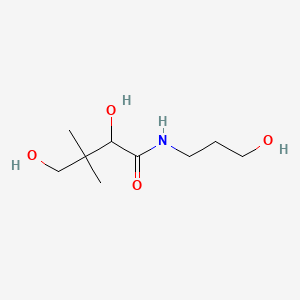
2,4-dihydroxy-N-(3-hydroxypropyl)-3,3-dimethylbutanamide
References
- 1ISO 16128-1:2016 and ISO 16128-2:2017 — Guidelines on technical definitions and criteria for natural and organic cosmetic ingredients and products. ISO, Geneva.
- 2Panthenol. PubChem CID 4678. National Center for Biotechnology Information. pubchem.ncbi.nlm.nih.gov ↗
- 3PANTHENOL. CosIng — European Commission cosmetic ingredient database. ec.europa.eu/cosing ↗
- 4PANTHENOL. CosIng u2014 European Commission database for information on cosmetic substances and ingredients. https://ec.europa.eu/growth/tools-databases/cosing/search?search=PANTHENOL