Why the score varies
This ingredient is made commercially by more than one route, and ISO 16128 scores the feedstock actually used. Without a supplier certificate of origin the value cannot be claimed.
| Route | Feedstock | NOI | Share | Notes |
|---|---|---|---|---|
| Extraction | Coffee beans, tea leaves | 1.00 | Minority of world supply, common in cosmetics | Natural origin |
| Chemical synthesis | Urea + chloroacetic acid (petrochemical) | 0.00 | Majority of world supply | Fully synthetic |
How we scored it
How it’s made
Where it comes from
Two routes: extraction from coffee or tea (decaffeination co-product) and synthesis from urea, methylamine and chloroacetic acid.
Caffeine, also known as 1,3,7-trimethylxanthine, is a naturally occurring alkaloid. In the context of cosmetic ingredients, it is overwhelmingly obtained through extraction from plant sources rather than de novo synthesis. The most common sources are coffee beans and tea leaves, which are rich in caffeine.
The extraction process typically involves several steps to isolate and purify the caffeine from the plant matrix. Initially, the plant material is often ground and then subjected to solvent extraction. Common solvents include hot water, ethanol, or supercritical carbon dioxide (scCO2). Water extraction is a traditional method, while scCO2 extraction is favored for its ability to yield a high-purity product with minimal residual solvent and its environmentally friendly nature.
Following the initial extraction, further purification steps are necessary to remove impurities such as tannins, lipids, and other plant metabolites. This can involve techniques like precipitation, filtration, and recrystallization. For instance, after water extraction, the solution might be treated with lead acetate to precipitate tannins, followed by filtration. The caffeine can then be recovered from the filtrate. Recrystallization, often from hot water or ethanol, is a crucial step to obtain crystalline caffeine of cosmetic grade purity.
While synthetic routes to caffeine exist, they are not the dominant method for cosmetic ingredient supply. These synthetic pathways typically start from simpler organic molecules like urea and cyanoacetic acid derivatives, involving multiple reaction steps such as condensation, cyclization, and methylation. However, the cost-effectiveness and the consumer preference for naturally derived ingredients make extraction from plant sources the commercially preferred and dominant method for cosmetic-grade caffeine.
In plain English
Caffeine is a well-known stimulant found naturally in coffee beans and tea leaves. In skincare products, it's often included for its ability to help reduce the appearance of puffiness and redness, thanks to its vasoconstrictive properties which can temporarily tighten the skin. It's also recognized for its antioxidant benefits, helping to protect the skin from environmental stressors.
For cosmetic use, caffeine is primarily obtained by extracting it directly from these natural plant sources. Think of it like making a strong cup of coffee or tea, but with specialized processes to isolate just the caffeine molecule in a pure form. This extraction method is considered natural and aligns with the growing consumer demand for ingredients derived from renewable resources.
While it's possible to create caffeine in a laboratory through chemical synthesis, the vast majority of caffeine used in cosmetics comes from nature. This natural origin is why it's classified as a renewable ingredient.
CosIng definition: Caffeine is the heterocyclic organic compound that conforms to the formula
Natural alternatives with the same function
A stabilised, water-soluble form of vitamin C used as an antioxidant and humectant in skincare. It is made…
Acacia Catechu Wood Extract 100% natural originAn extract of the heartwood of the black catechu tree, rich in plant polyphenols such as catechin. It…
Acer Palmatum Leaf Extract 100% natural originA plant extract from Japanese maple leaves, valued as an antioxidant. It's produced by simple extraction from the…
Achillea Millefolium Flower Extract 100% natural originAn extract made from yarrow flowers, a plant long used in traditional herbal preparations. Used to help condition…
Adenosine 100% natural originAdenosine is a naturally occurring compound found in all living cells, playing a vital role in energy transfer…
Aesculus Hippocastanum Extract 100% natural originAn extract from the horse chestnut tree, used to soothe and protect skin and tighten its surface feel.…
Structure
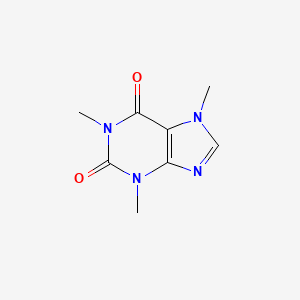
1,3,7-trimethylpurine-2,6-dione
References
- 1ISO 16128-1:2016 and ISO 16128-2:2017 — Guidelines on technical definitions and criteria for natural and organic cosmetic ingredients and products. ISO, Geneva.
- 2Caffeine. PubChem CID 2519. National Center for Biotechnology Information. pubchem.ncbi.nlm.nih.gov ↗
- 3CAFFEINE. CosIng — European Commission cosmetic ingredient database. ec.europa.eu/cosing ↗
- 4CAFFEINE. CosIng u2014 European Commission database for information on cosmetic substances and ingredients. https://ec.europa.eu/growth/tools-databases/cosing/search?search=CAFFEINE